The History of
Panasonic Bicycles
From the origins of National bicycles in Japan to Panasonic's presence in North American bike shops and international racing, explore the people, milestones, and machines behind the name.
From National to Panasonic
Konosuke Matsushita, founder of the business that became Panasonic, had an early connection to the bicycle trade. The museum's original history recounts his childhood association with a family bicycle shop and his interest in improving products for cyclists.
In Japan, the company's products were known under the National name. Panasonic became a familiar name on products marketed internationally, including bicycles.
The museum's original account emphasizes quality across the bicycle range, from higher-end racing models to accessible models such as the Sport 500.
The history also notes the connection between Matsushita's bicycle businesses and Panaracer tires. The precise history of synthetic tubular tire development warrants additional documentation.


A historical timeline
The milestones below are adapted from the museum's original historical chronology. Some claims and dates still require independent source verification.
1918–1958 · Foundations
Matsushita Electric founded, later known as Panasonic.
Battery-powered bicycle headlamp developed and distributed to bicycle dealers.
Bicycle frame production begins.
Roadster bicycle production by C.K.D.; the original timeline also lists establishment of National Tire Company without a separate date.
Sport-type bicycle production begins.
JIS certification-mark license received for bicycle frames from Japan's Ministry of International Trade and Industry (MITI).
1962–1974 · Growth
JIS certification-mark license received for complete bicycles.
Factory established in Kashihara, Osaka Prefecture; National Bicycle Industrial Co. established, according to the original chronology.
Japanese national bicycle racing team reportedly uses the company's bicycles in world championship competition.
Exports begin to Panasonic Company U.S.A. and Schwinn Bicycle Company in the United States.
Japanese Olympic cycling team uses the company's racing bicycles for Munich.
Quality-control recognition from the Osaka division of MITI.
Gojyo National Bicycle Parts Co., Ltd. established as a wheel assembly factory.
1976–1980 · International reach
Japanese Olympic cycling team reportedly uses the company's bicycles at Montreal. Racing and ten-speed bicycles displayed at Philadelphia's Franklin Institute during the U.S. Bicentennial celebrations.
Exports of frames and bicycles begin to Europe. The original chronology also lists exports to Canada and Australia and organization of a U.S. Panasonic/Shimano racing team, without separate dates.
Exports to T.I. Raleigh (U.S.A.) begin. The original history also reports Japanese Olympic team use of the company's racing bicycles for the Moscow Games.
1989 · A changing market
According to the original museum history, Panasonic withdrew from the North American bicycle market amid unfavorable dollar–yen exchange economics.
Panasonic in North America
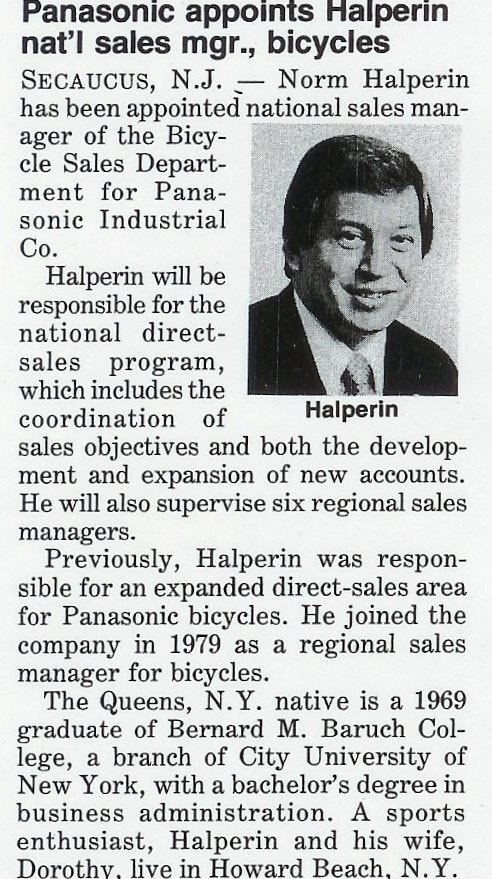
Panasonic began exporting bicycles to the United States in 1971, during the American bicycle boom. The museum later connected with Norman Halperin, a former national sales manager for Panasonic's U.S. bicycle division.
According to the museum's account, Halperin joined Panasonic on April 19, 1979, as a sales representative covering metropolitan New York, New Jersey, and Connecticut. At the time, the company reportedly had only one other U.S. sales representative, based in Chicago.
After that colleague departed approximately six months later, Halperin found himself among the most experienced members of the U.S. sales team. As Panasonic expanded its national distribution, he became national sales manager and recruited representatives across the country.
Source: PBVM's original historical account of its conversations with Norman Halperin. Further documentation and recollections are welcome.
The bicycles behind other badges
Panasonic's manufacturing story extends beyond bicycles bearing its own name. The original PBVM history identifies Schwinn, Raleigh, Royce Union, Suteki, Centurion, and other brands as having sold Panasonic-built bicycles at various times.
Among the best-known examples cited are Schwinn's early-1970s World Traveller and World Voyager bicycles and later LeTour models. Model-specific production histories can vary by year and market, so individual attributions should be checked against catalogs and other period documentation.
Panasonic racing heritage
Panasonic-supported bicycles and teams appear throughout the museum's historical chronology, including references to Japanese national and Olympic cycling programs and the Panasonic/Shimano racing organization in the United States.
A fuller illustrated history of Panasonic's racing teams remains an opportunity for future research. For background, see the Panasonic cycling team overview; it should not be treated as the museum's primary historical source.